

Safety Integrity Level (SIL)
Background & About the Course
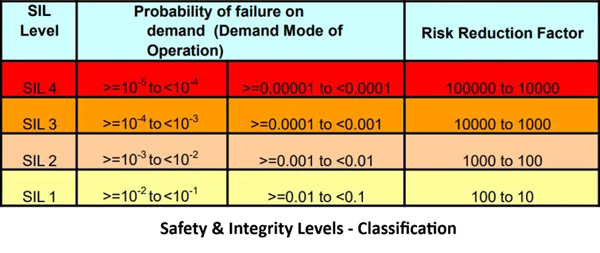
In functional safety, Safety Integrity Level (SIL) is defined as the relative level of risk reduction provided by a Safety Instrumented Function (SIF). It measures the performance required from a SIF to ensure safety. According to the IEC 61508 standard, there are four SIL levels, with SIL4 being the most reliable and SIL1 the least. The applicable SIL is determined based on quantitative factors combined with qualitative factors, such as risk assessment and safety lifecycle management.
The design process encompasses everything from procurement, engineering work, construction, to commissioning, with safety considerations integrated at every stage. This Safety Integrity Level (SIL) training program equips participants with the skills to design, analyze, and create engineering reports for projects while considering the safety factors of the designs produced.
Course Objectives
This training aims to:
- Understand the fundamental concepts and importance of
- (SIL) in industrial safety systems.
- Explain the relationship between operational risk and the required safety integrity level in a process.
- Identify methods for determining the appropriate SIL based on risk analysis and system requirements.
- Understand international standards such as IEC 61508 and IEC 61511 relevant to SIL.
- Provide knowledge on the selection, application, and evaluation of hardware and software to achieve the targeted SIL.
- Develop skills for verifying and validating SIL in safety instrumentation systems.
- Enhance awareness of functional safety and its impact on operational performance.
Who Should Attend
Recommended Participants:
- Engineers and Managers working in Process Safety, Instrumentation, and Control Systems.
- HSE (Health, Safety, and Environment) Teams
- Maintenance and Reliability Professionals
- Safety Auditors and Consultants
Course Outline
- Functional Safety Overview & Safety Instrumented System Scope
- Fundamentals of Safety Integrity Level Engineering
- Overview of Process Control
- Components of Control Loops
- Steps for Safety Integrity Level Analysis
- Hazard Identification Techniques
- Risk Estimation and Calculation
- Risk Reduction Requirements & Tolerable Risk
- Determining Safety Functions and SIL Targets
- Safety Integrity Levels, Risk Reduction Factor (RRF), & Probability of Failure
- SIL Management and Lifecycle
- Case Studies
About the Course Leader
Ir. In Jumanda Kasdadi, M.T.
Mr. Jumanda is a dedicated lecturer with nearly 280 training sessions conducted across various industries, particularly in oil and gas, since 1997. He holds both Bachelor’s and Master’s degrees in Chemical Engineering from the Bandung Institute of Technology. Additionally, he completed nine specialized courses in the oil and gas sector at PETEX (Petroleum Extension), University of Texas at Austin, in 2018.
Mr. Jumanda possesses numerous professional certifications, including a Lecturer Certificate from the Indonesian Minister of Education, Construction, Electrical, and Fire Protection Certificates from the HSE Association Indonesia (ALPK3), and Risk-Based Inspection (RBI) Facilitator certification. He is also certified in Instrumentation Engineering Design for Oil & Gas Projects with INtools and has qualifications in HAZOPS and HAZID from the Indonesian Certifying Agency (BNSP).
He has trained prestigious companies in capital-intensive industries, including Pertamina, Chevron, Total Indonesie, and Freeport, among others. Mr. Jumanda has been involved in key projects such as Feasibility Studies (FS), Front-End Engineering Design (FEED), and SIL Classification, showcasing his extensive expertise in the oil and gas industry.
Public Training berikutnya : 16 – 18 November, 2026